A private intelligence that listens, remembers, and compounds context across the relationships in your life — and surfaces the patterns no one else can see. Not advice. Not verdicts. Just clearer signal.
MetaopAI is a private journal paired with an AI signal intelligence engine that turns your everyday narrations about life — yourself, the people around you, your environments, and your relationships — into structured, persistent signals. Instead of treating entries as disposable chat messages that get lost in context-window collapse, the system extracts behaviors, events, emotional framing, and relationship dynamics, then stores them in a governed Knowledge Representation Layer (KRL) organized across four clear scopes: USER, ENTITY, SPACE, and RELATIONSHIP_PAIR.
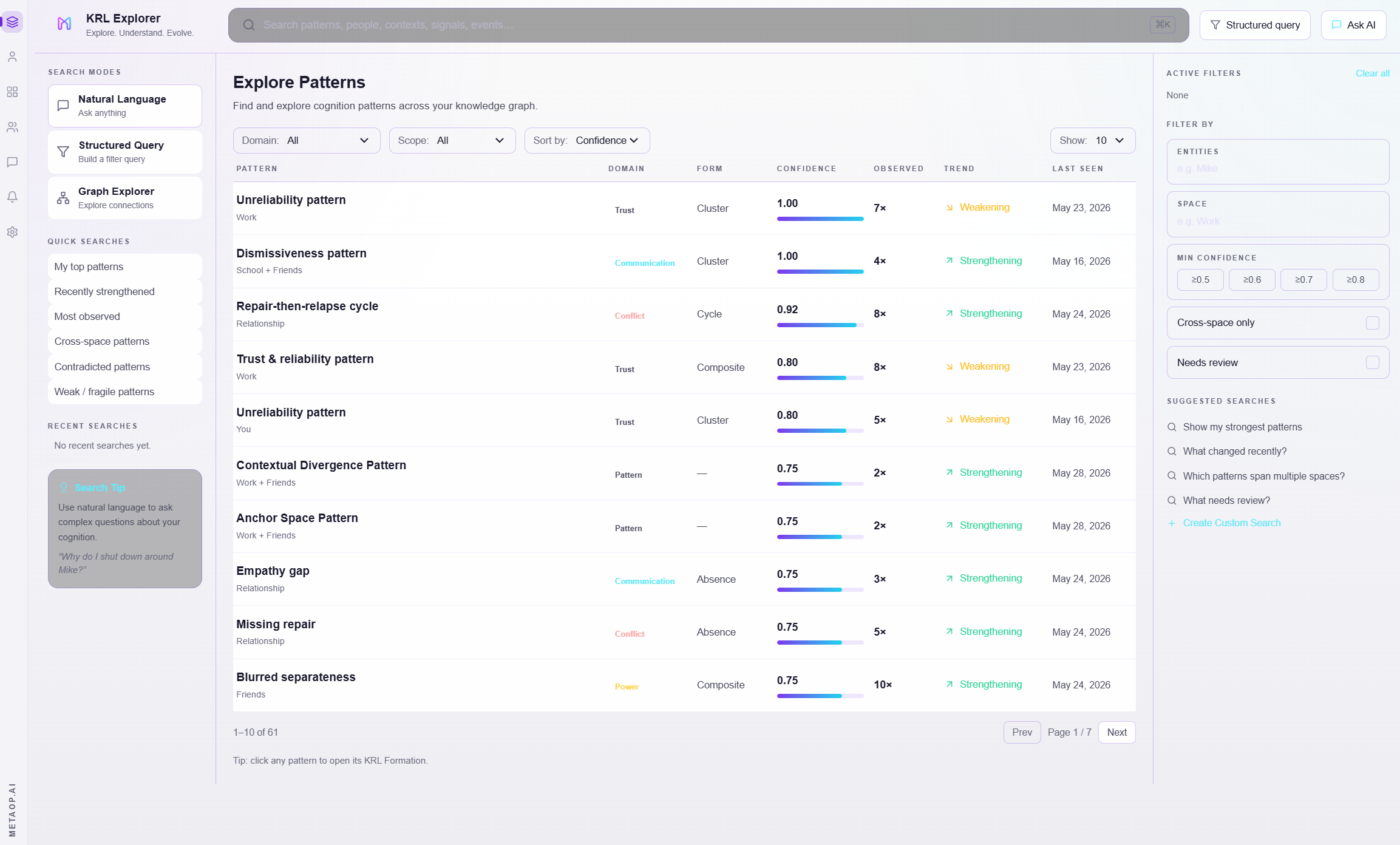
Over time, MetaopAI's Pattern Engine correlates these signals to surface meaningful patterns — trust cycles, withdrawal loops, reciprocity shifts, repair-and-relapse rhythms — with evidence, confidence scores, and provenance, never judgment. It sits in the gap between a partner (context but no neutrality), a friend (neutrality but no confidentiality), a therapist (expertise but limited scale), and a general-purpose AI (intelligence but no real memory). The result is true continuity that compounds for months and years, so you're finally understood by a system that actually remembers and makes sense of your real life.
Be understood. Operate with clarity.
A friend who's pulling away. A manager whose tone shifted last month. A partner whose evenings feel a little different lately. You sense something — but you can't quite name it. So you reach out for help.
Today, you have four choices. None of them are built for this.
The thing you actually want is something that holds your story — that listens carefully, remembers precisely, and tells you what it sees over time. Without bias. Without verdicts. Without forgetting.
The dominant conversation in AI is about bigger models, better reasoning, longer context windows. All of that matters. But for the kind of dialogue a person actually needs — substantive, accumulating, personally relevant — there's a different question worth asking.
What if the missing layer isn't the model itself, but the way context is structured around it? What if "memory" alone isn't enough — what's needed is a typed, multi-dimensional state that grows in fidelity, decays appropriately, surfaces contradictions, and compounds raw observation into emergent pattern?
MetaopAI is an experiment in that direction. We're not claiming to have solved anything. We're modeling context the way an attentive observer would — and seeing how far that takes us toward AI dialogue that is both more precise and more honest about what it cannot know.
Raw signals are cheap.
Structured signals over time are not.
The product side is simple. You narrate. The system extracts. Patterns surface. You see yourself and the people around you more clearly than you did yesterday.
Write the way you'd talk to a confidant. No prompts to learn, no structure to follow. Tell the story as it happened.
Five parallel extractors identify who, what, where, when, and how — typed observations land in a structured graph.
Signals reinforce, contradict, decay. Compounded across days and weeks, dynamics become visible that no single conversation could have shown.
Patterns named. Sources cited. Alternative readings offered. You stay in the chair — the system shows its work, never renders a verdict.
Under the hood, MetaopAI is built on a typed, multi-dimensional knowledge graph called the KRL. Every observation lands in a specific cell — by subject (the user, an entity, a space, or a relationship pair) and by layer (signal, event, meta-context, context, or pattern).
Stable layers are queried first. Volatile layers update on every turn. Patterns are not extracted — they're computed across the lower layers, with confidence scores, time-decay, and contradiction detection built in.
Small behavioral observations. Raw, granular, highly volatile. The texture of moment-to-moment interaction.
Discrete happenings with timestamps. The argument on Tuesday. The promotion in March. Anchors in time.
Profile facts & identity. Who someone is, what role they play, the stable scaffolding of a relationship.
Longitudinal interpretations. Computed, not extracted. Reinforced, decayed, reactivated as the lower layers evolve.
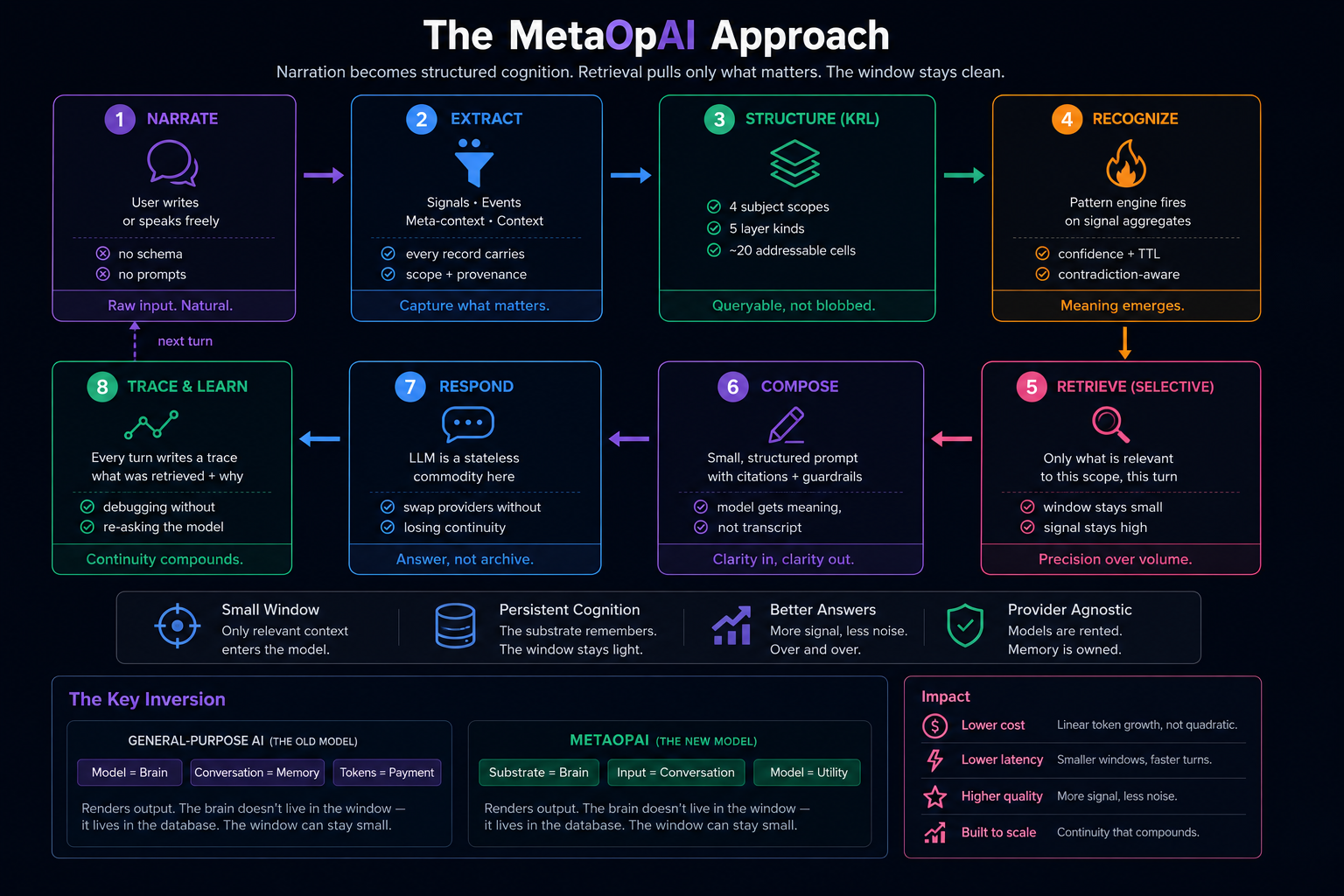
The substrate above is the memory. Here's how MetaopAI turns it into a response — first the loop, then the runtime brain, the package it hands the model, the map back to the product, and what it all costs.
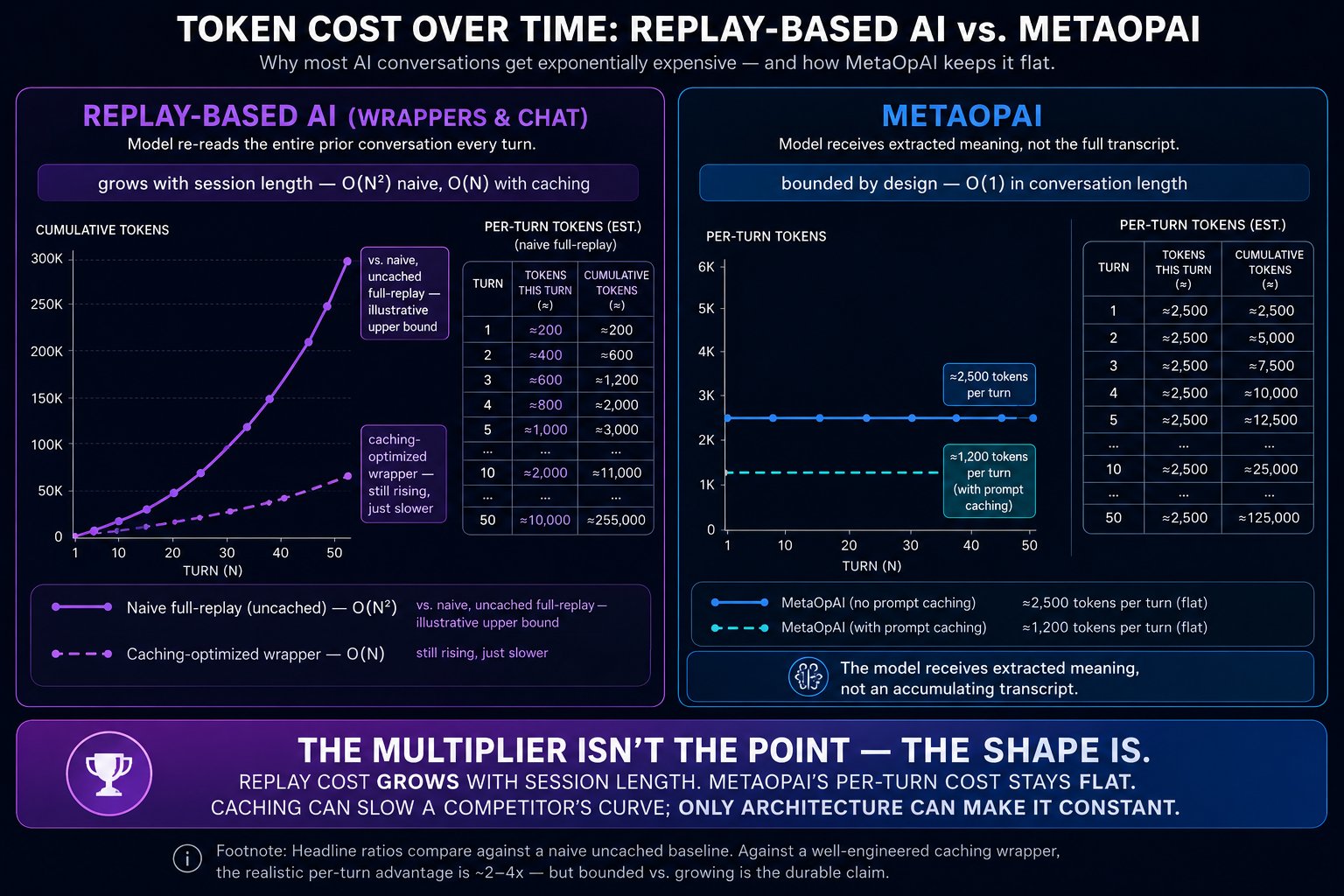
General-purpose AI treats the conversation as memory and pays for it on every turn. MetaopAI inverts this: narration becomes structured cognition, retrieval pulls only what's relevant to this scope, and the model becomes a stateless commodity you can swap without losing continuity.
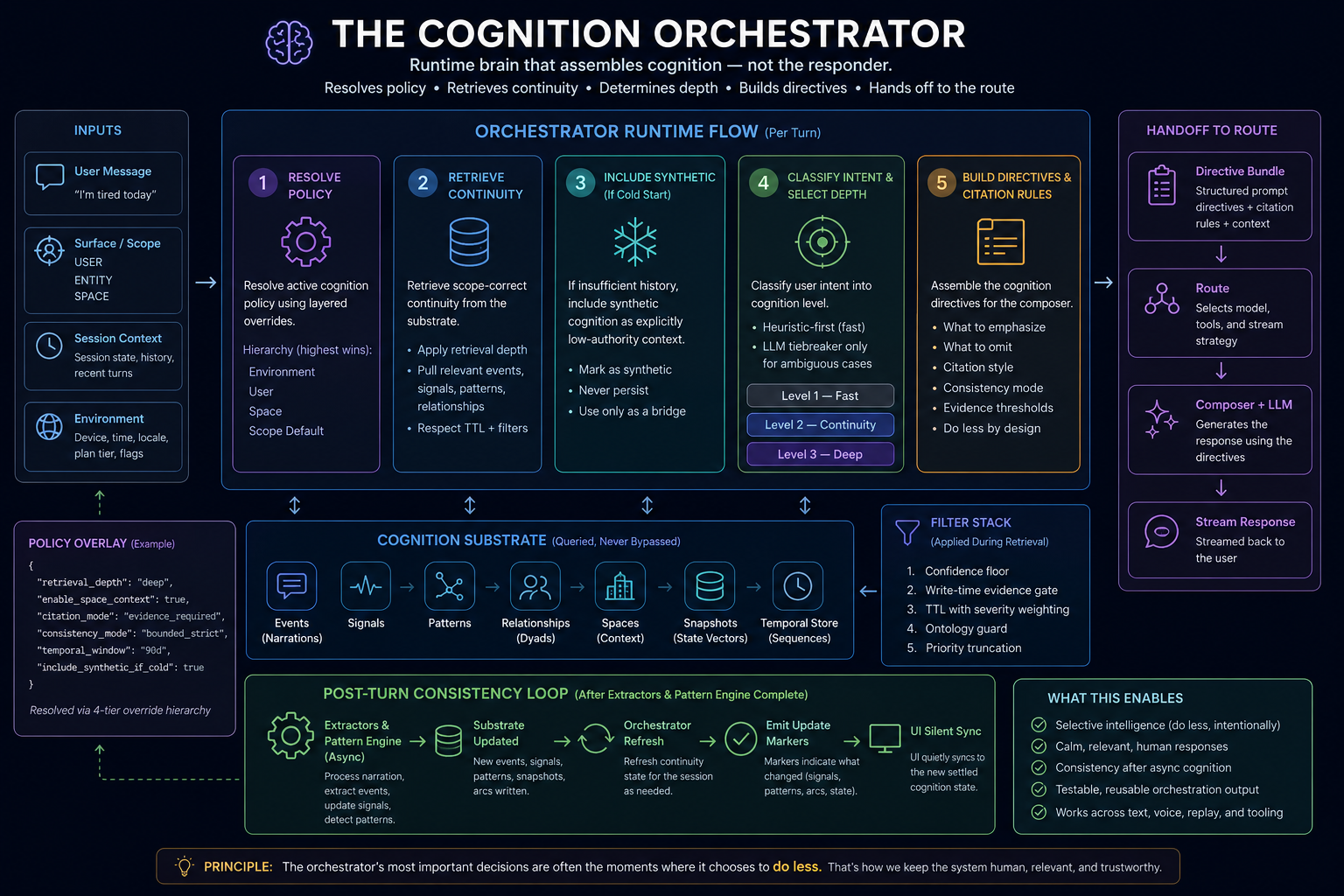
Every turn, the orchestrator resolves the active policy, retrieves scope-correct continuity from the substrate, classifies intent to decide how deep to think, and builds the directives the composer hands to the model. Its most important decisions are often the moments it chooses to do less.
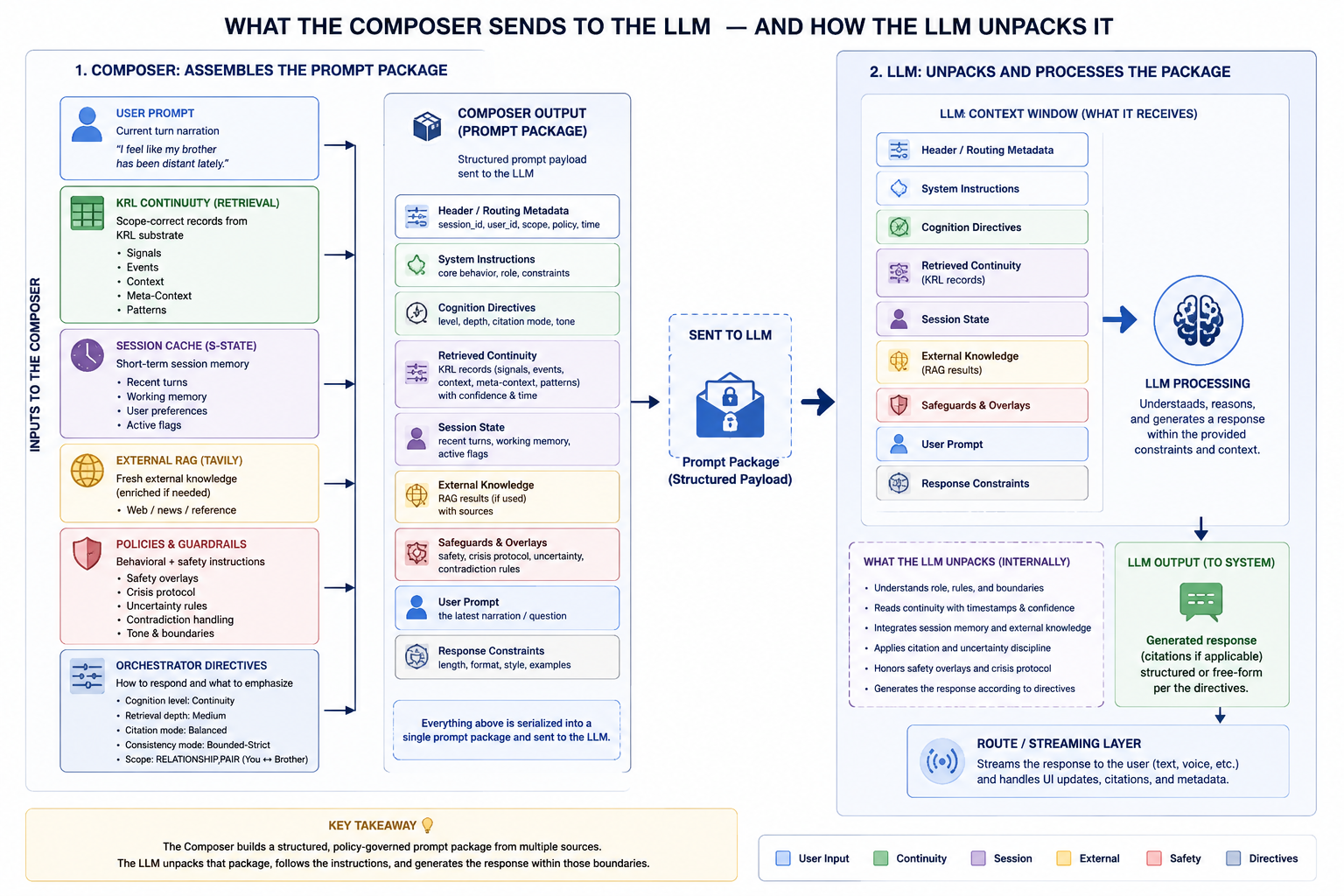
The composer takes the orchestrator's directives and assembles a single, policy-governed prompt package — scope-correct continuity, session state, fresh external knowledge, safeguards, and the user's prompt. The model unpacks that package, follows the instructions, and answers strictly within those boundaries.
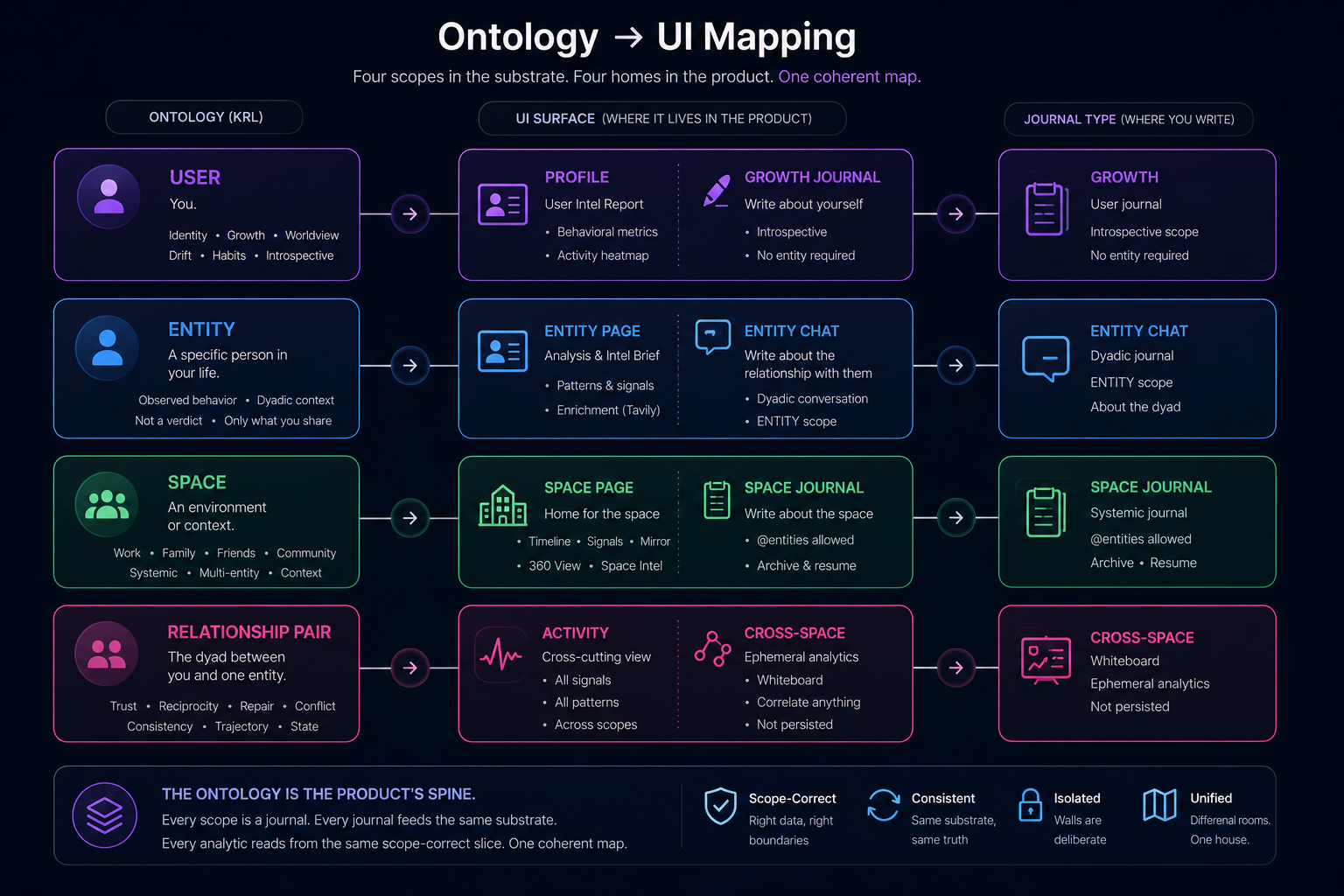
The ontology is the product's spine. User, Entity, Space, and Relationship-pair each map cleanly to where you write and where intelligence is surfaced — every scope is a journal, every journal feeds the same substrate, and every analytic reads from the same scope-correct slice.
Replaying the whole conversation every turn means cost grows quadratically — it feels exponential as a thread gets long. Keeping context small and scope-correct holds per-turn cost roughly constant, so cost grows linearly with use. The gap widens the longer someone stays.
The hardest design constraint in this product is the one most other AI tools quietly violate. An AI that observes someone's interactions can legitimately surface what it sees. It cannot legitimately render judgment on people it has never met.
"Mike's response time has stretched in the last month. Previously same-day; now averaging two days. Cited from 7 journal entries between Apr 12 – May 8."
A grounded observation. Evidence is cited. The user can audit the trail. The interpretation is theirs to make.
"Your manager Mike is avoiding you. He probably has a problem with your performance or is being passive-aggressive about the promotion."
A verdict. Closes inquiry. Speculates on motive. No AI is qualified to render this kind of judgment about a third party.
Gradual decrease in responsiveness, warmth, or engagement over time — too gradual to notice in any single conversation.
Statements or behaviors that conflict with prior context, surfaced with both observations rather than silently overwritten.
Conflict followed by repair (or the absence of it). Cycles that repeat suggest something the user already knows but hasn't named.
Increasing distance, reduced openness, emotional fading — across multiple interaction surfaces with the same entity.
Stressors compounding across people and events within a space, not isolated to any one relationship.
Patterns that fired before, went quiet, and are firing again — framed differently than a first-time observation.
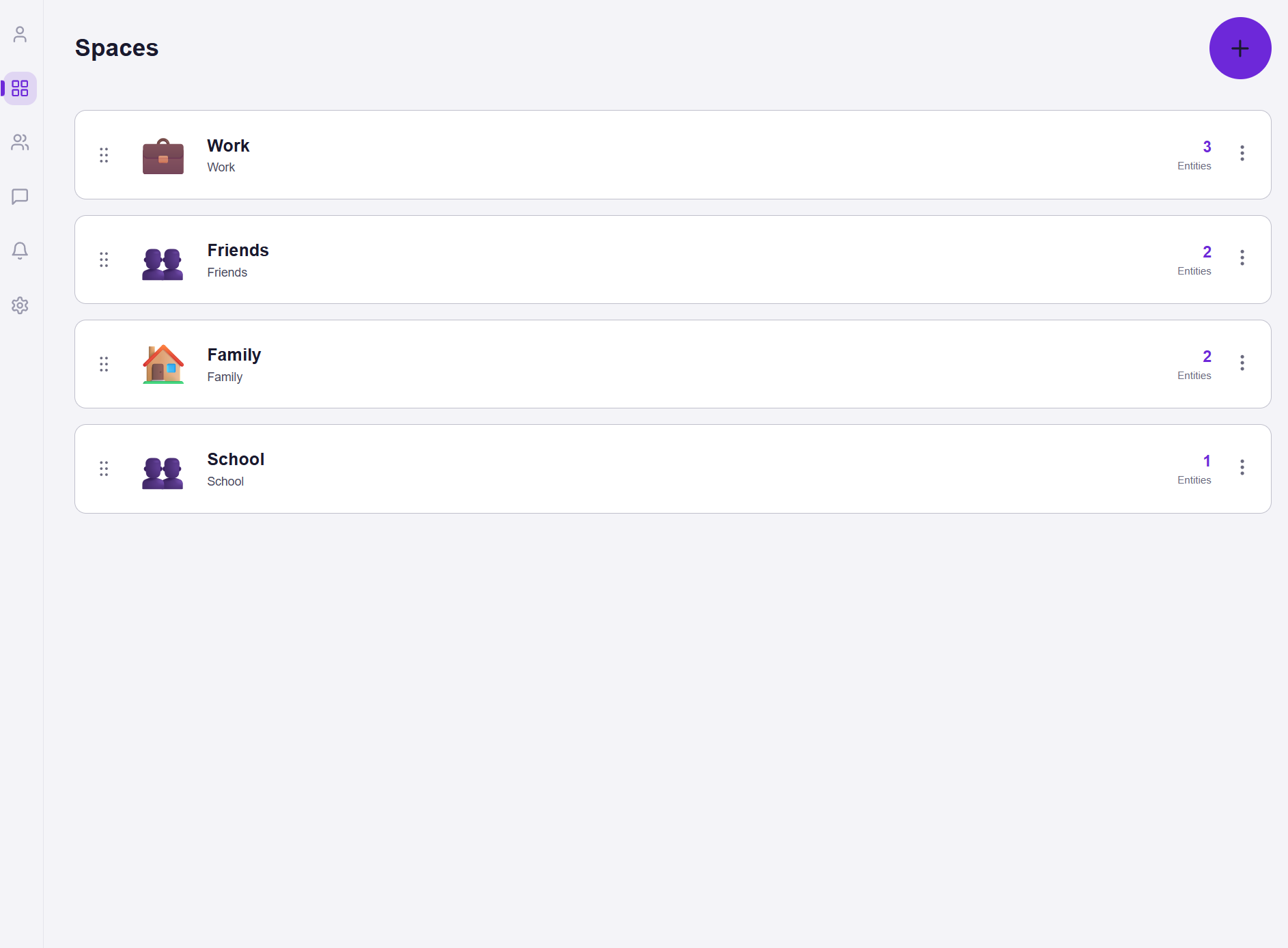
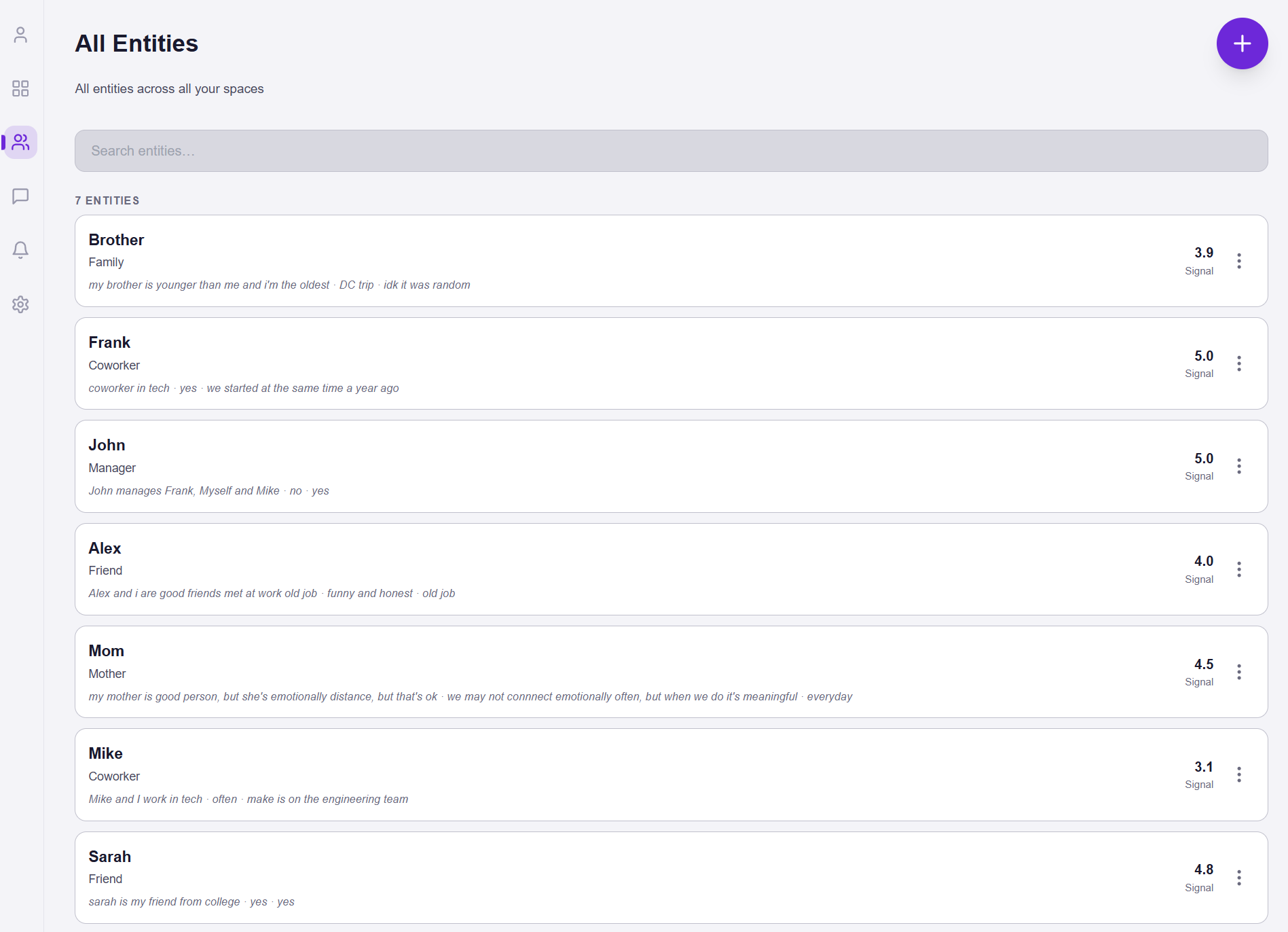
Spaces organize life. Entities model the people in it. Your profile is the longitudinal portrait of you. Ten distinct chat surfaces — Journal, Mirror, View 360, Predictive, Cross-Space, Entity Narration, Space Analysis, Score Explained, Burst, Observer Signals — query the same underlying context in different voices.
Family. Work. Friends. School. Romantic. Different contexts have different rules — MetaopAI keeps them separate, and lets intelligence flow between them only when it matters.
Every recurring presence in your life — partner, manager, sibling, coworker, friend — gets modeled as a living entity. Not a contact card. A signal score that evolves with every interaction you describe.
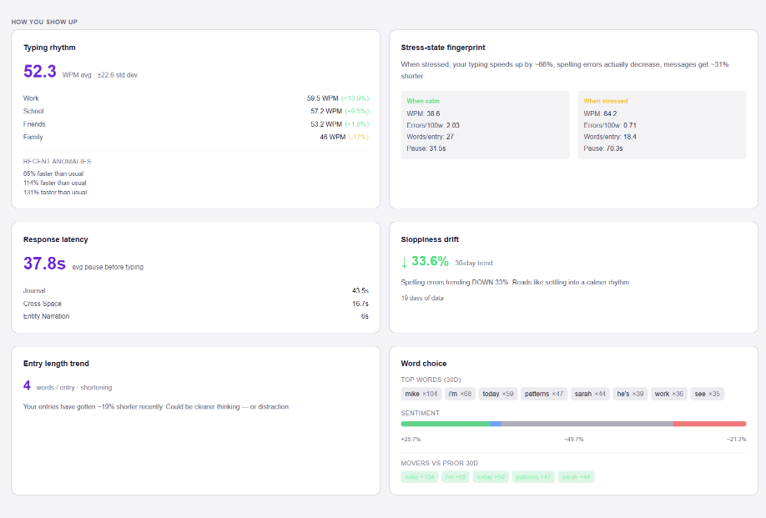
Your profile is the shape of you over time — where your attention actually goes, who holds it, how your rhythm shifts when you're under stress. Not a static bio. A living read of how you operate in the world you've built.
Everything the system has ever learned about you and the people around you lives in the KRL — structured, typed, and browsable. KRL Analytics puts a direct window on that substrate: explore the graph of relationships and patterns, trace how any signal formed, and see exactly what the AI knows before it speaks.
These are not features. They're commitments — the lines that don't move regardless of what's convenient to ship.
The system surfaces what it observes and shows its work. It does not diagnose people, predict motives, or render judgment on anyone in your life. You stay in the chair.
Every interpretation carries a confidence score. Recent observations weigh more than year-old ones. Patterns that go dormant decay; patterns that reactivate are surfaced with appropriate framing.
Every surfaced pattern cites its source signals. You can audit the trail. You can dismiss a pattern. The AI never insists — it offers, and the offering can always be questioned.
A shared safety module fires before any other reasoning across every chat surface. When the conversation moves into high-stakes territory, the AI bridges you to a human resource — it does not try to be the resource.
The goal is clarity outside the system — better-handled conversations in your actual life. Not engagement inside an app. We measure success by how capable you feel out there, not by how often you come back.
Every narration, every signal, every pattern is encrypted. We hold the data you generate to the same standard you hold your private thoughts.
For over a decade, I've worked in security and cloud infrastructure across global financial institutions, helping design and secure systems that support critical platforms and emerging technologies. Over the last several years, that work increasingly shifted toward AI — evaluating enterprise tools, securing deployments, and understanding how context, orchestration, and human behavior shape AI systems in practice.
MetaOpAI emerged from a simple observation: most AI systems treat interactions as isolated moments. People don't operate that way. Relationships, decisions, patterns, and behavior are built over time through accumulated context. MetaOpAI is an exploration of what happens when AI is designed to retain signal across those moments rather than continuously resetting the conversation.
This project remains intentionally small and hands-on. The architecture, safety systems, infrastructure, and underlying design are built with the same principles used in security engineering: deliberate decisions, observable systems, and a bias toward long-term reliability over short-term complexity.
The belief behind MetaOpAI is straightforward: context compounds. Small signals become patterns, patterns become understanding, and understanding creates clarity.
The complete reference, plus three focused cuts — a product walkthrough, an investor view, and a technical deep-dive. Pick the read that fits.
The complete merge. Positioning, philosophy, the cognition substrate, the orchestrator, the pattern engine, safety, and economics — the whole picture in one document.
Read the full whitepaper 02 — Focused Product & curious readersWhat the product is and how it feels to use. Spaces, entities, the profile, the ten chat surfaces, and the ontology that ties every screen back to one substrate.
Read the product view 03 — Focused Investors & advisorsPositioning, defensibility, and the economics of pattern-not-verdict AI. The structural moats, the unit-economics math, and the honest disclosures.
Read the investor view 04 — Focused Engineers & technical readersSchema, pipeline, latency profile, eval roadmap, and deployment specifics. The KRL matrix, the extraction pipeline, the orchestrator, and the safety module in implementation detail.
Read the technical referenceMetaopAI is a probabilistic interpersonal cognition system. It extracts signals, events, and emotional atmosphere from what you write, structures them in a typed Knowledge Representation Layer, models the relationships and spaces in your life as evolving state, and compounds recurring observations into longitudinal patterns — with confidence scoring, contradiction handling, and temporal decay built in.
Not an oracle that claims to know the truth. A contextual interpretation engine that gets sharper the longer you write.
Confidence over certainty.
Interpretation over diagnosis.
Patterns, not verdicts.